

The Global Artificial Intelligence Avatar Market is rapidly evolving as AI-driven digital humans, virtual assistants, and interactive avatars become fundamental across entertainment, education, customer service, healthcare, gaming, and corporate communication.
As organizations increasingly seek more immersive, intelligent, and scalable engagement tools, AI avatars are emerging as a transformative technology capable of replicating human-like expression, communication, and behavior in digital environments. This shift marks a significant leap in how brands interact with consumers and how individuals interact with machines.
Market Overview
The Global Artificial Intelligence (AI) Avatar Market is estimated to reach USD 10.4 billion in 2025 and is anticipated to grow exponentially to USD 110.9 billion by 2034, registering an impressive CAGR of 30.1%. This accelerated growth is fueled by rising adoption of virtual influencers, conversational avatars, digital educators, hyper-personalized marketing tools, and AI-driven customer support systems. AI avatars integrate advanced machine learning, natural language processing, facial animation, and generative AI technologies to deliver lifelike interactions that surpass traditional chatbots and automated systems.
This rapid growth is not only driven by entertainment and social media applications but also by enterprise demand for scalable communication solutions. Companies are leveraging AI avatars to provide 24/7 multilingual customer support, personalized onboarding, virtual training, and sales assistance. At the same time, consumers are increasingly engaging with digital humans through virtual events, gaming universes, social platforms, and emerging metaverse environments. As digital transformation accelerates, AI avatars represent a critical bridge between human communication and digital automation.
Market Dynamics
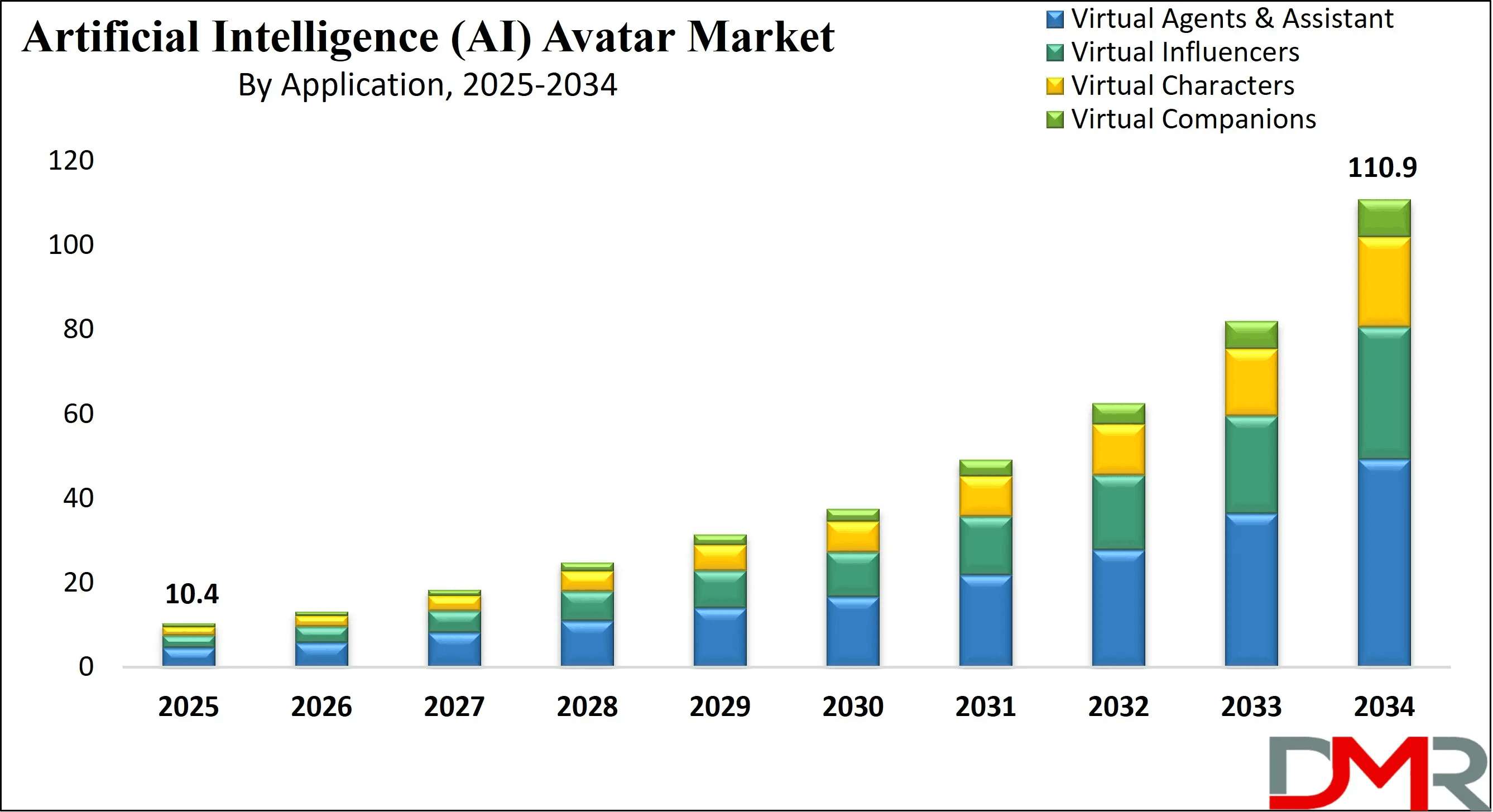
One of the core drivers behind the expansion of the AI avatar market is the societal shift toward immersive digital experiences. Modern consumers expect richer, more interactive engagements than simple automated texts or voice responses. AI avatars fulfill this expectation by adding expression, emotional intelligence, and realism to digital communication. This makes them particularly valuable in sectors relying on human interaction, such as healthcare support, education, tourism, retail, and financial advisory services.
Additionally, the adoption of generative AI has dramatically expanded avatar capabilities, enabling systems that can generate speech, facial expressions, and gestures in real-time. With advancements in 3D rendering, lip-syncing, and natural language understanding, avatars are increasingly capable of maintaining context-rich, emotionally aware conversations. This pushes them beyond novelty and into mainstream enterprise utility.
Enterprises are also adopting AI avatars to reduce operational costs while enhancing user experience. Instead of relying on large human support teams, organizations deploy AI avatars to handle high-volume customer queries consistently and efficiently. This reduces response time, improves service quality, and frees human employees to focus on complex queries.
However, the market does face challenges. Concerns around data privacy, ethical use of deepfake-like technologies, and high implementation costs may affect short-term adoption. Small businesses may struggle with the investment required to build high-fidelity avatars. Yet, cloud-based avatar creation tools and customizable avatar platforms are steadily reducing barriers, enabling even small organizations to adopt this technology cost-effectively.
Market Segmentation
The AI avatar market can be understood through its major application segments, each contributing uniquely to market expansion. Customer service avatars form a dominant segment, used widely in banking, telecom, retail, and e-commerce for conversational support and interactive assistance. These avatars transform customer experience by offering human-like interactions with the efficiency of automation.
Entertainment and media are rapidly expanding segments where avatars appear as digital influencers, livestream hosts, virtual performers, and characters within gaming ecosystems. Virtual influencers have become especially popular for brand endorsements and marketing campaigns due to their scalability, consistency, and creative flexibility.
Education and training represent another critical segment. AI avatars are used for personalized learning, language tutoring, corporate training, simulation-based skill development, and virtual classroom assistance. Their ability to convey information interactively supports higher engagement and better learning outcomes.
In healthcare, avatars play roles in patient engagement, appointment management, preliminary consultations, therapeutic guidance, and elderly care assistance. Digital humans offer a gentler and more empathetic interface compared to traditional chatbots.
Finally, corporate communication is a growing segment where AI avatars support employee onboarding, HR processes, training videos, and internal communication. Their ability to deliver consistent messaging makes them ideal for large, distributed workforces.
Regional Analysis
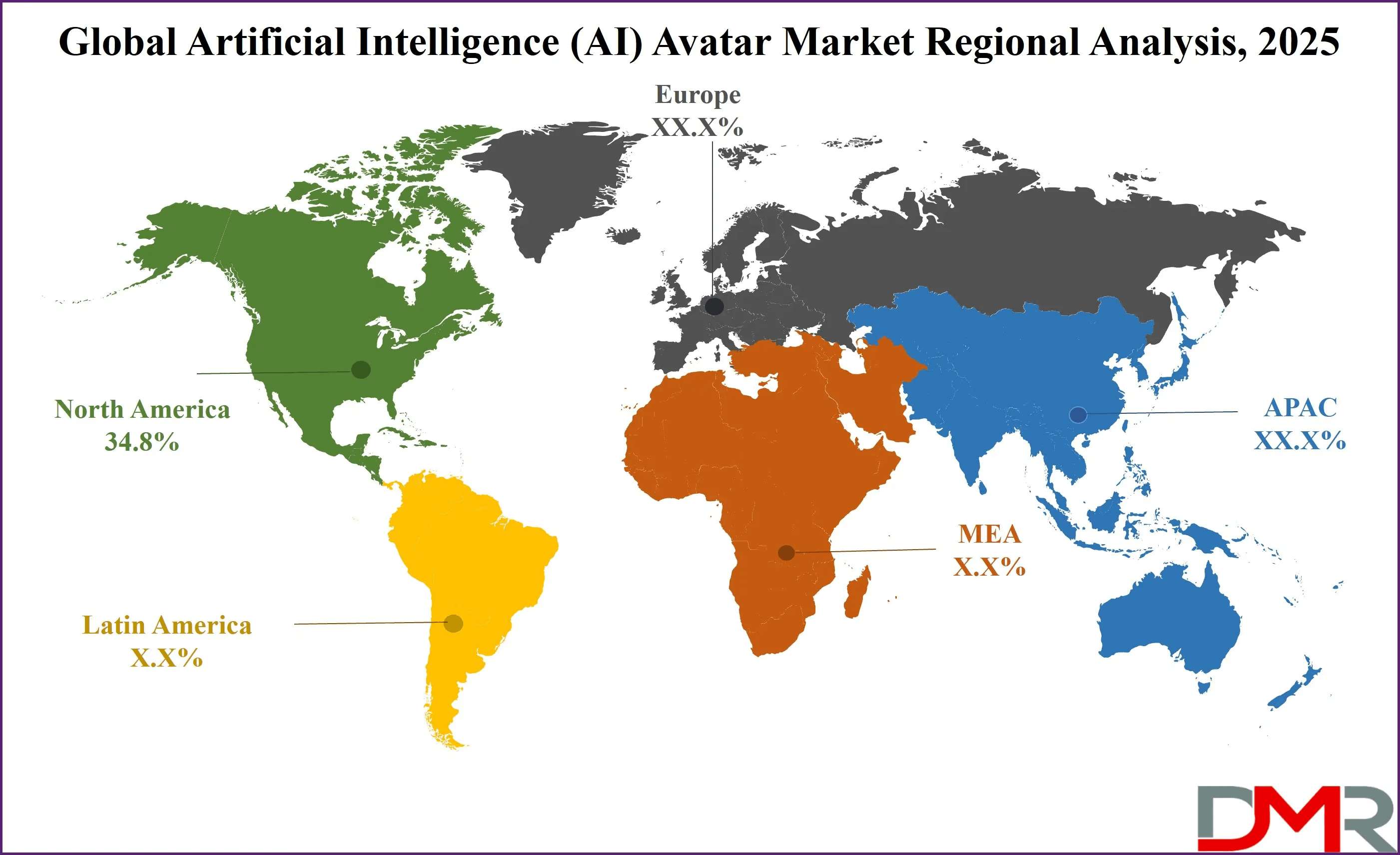
North America is projected to dominate the global artificial intelligence avatar market in 2025, capturing 34.8% of total market revenue. This leadership position is driven by the region’s cutting-edge digital ecosystem, advanced technological adoption, and concentration of major AI and technology companies pioneering avatar development.
The United States remains the innovation hub for AI avatars, with major players advancing capabilities across sectors such as entertainment, healthcare, education, customer service, and virtual commerce. Companies including Meta, Microsoft, NVIDIA, and Google are accelerating efforts in hyper-realistic avatar creation, conversational intelligence, and generative rendering technologies. The region’s gaming industry, virtual production studios, and immersive media companies also contribute to strong demand.
Furthermore, North America’s robust adoption of metaverse applications, digital engagement strategies, and virtual events amplifies the need for intelligent avatars. Enterprises in the region are leveraging avatars to reduce operational costs, enhance digital support models, and maintain consistent user experiences across multiple platforms. Strong digital infrastructure, supportive innovation programs, and high consumer engagement further strengthen market potential.
Download a Complimentary PDF Sample Report : https://dimensionmarketresearch.com/report/artificial-intelligence-avatar-market/request-sample/
Competitive Landscape
The competitive landscape of the AI avatar market is shaped by rapid innovation, strategic collaborations, and continuous advancements in AI technologies. Technology leaders are focusing on developing hyper-realistic digital humans capable of expressive communication, emotional intelligence, and real-time interaction. Companies are integrating large language models and generative AI systems to enhance conversation quality and avatar responsiveness.
Collaboration between avatar developers, cloud platforms, and enterprise solution providers is expanding the adoption of customizable and scalable avatar platforms. Studios specializing in 3D graphics, animation, and motion capture are partnering with AI firms to push the boundaries of realism and interactivity. Startups are emerging with innovative solutions, such as low-cost avatar creation tools, digital influencer management platforms, and multilingual conversational engines.
Investment trends within the sector reflect increasing interest in personalized virtual assistants, synthetic media production, and digital identity platforms. As avatars become more central to digital transformation strategies, companies are prioritizing ethical AI practices, transparency, and privacy protection to ensure responsible adoption.
Future Outlook
The future of the Global Artificial Intelligence Avatar Market is characterized by deeper personalization, more immersive digital experiences, and seamless integration into both business and consumer applications. As generative AI evolves, avatars will become more context-aware, emotionally expressive, and aligned with human behavioral patterns. Development in real-time rendering, voice synthesis, and holographic communication will enable avatars to appear across physical and virtual environments.
The integration of avatars into metaverse platforms, AR/VR applications, and holographic communication tools will create new revenue streams across entertainment, tourism, education, and retail. Virtual employees, AI-powered sales agents, and digital companions will become mainstream, supporting hybrid workplace models and personalized customer journeys.
Enterprises will increasingly adopt avatars to automate corporate training, internal communication, and employee engagement. Healthcare applications will expand, especially in remote care, therapy, and patient engagement. Additionally, as avatar creation becomes more accessible through self-service platforms, global adoption will accelerate across industries.
Frequently Asked Questions (FAQs)
1. What is the Artificial Intelligence Avatar Market?
The Artificial Intelligence Avatar Market focuses on digital humans and AI-driven avatars designed for interactive communication, customer service, entertainment, education, and business applications.
2. What technologies power AI avatars?
Key technologies include machine learning, facial animation, natural language processing, generative AI, lip-sync algorithms, and real-time rendering systems.
3. Which region leads the AI avatar market?
North America leads the market with an estimated 34.8% revenue share in 2025 due to advanced digital infrastructure and strong presence of major AI innovators.
4. Where are AI avatars commonly used?
AI avatars are used across customer service, entertainment, education, healthcare, corporate communication, gaming, and metaverse platforms.
5. What is the future potential of AI avatars?
Future growth will be driven by immersive virtual experiences, generative AI advancements, metaverse adoption, and increased enterprise use of digital humans for communication and automation.
Summary of Key Insights
The Global Artificial Intelligence Avatar Market is expanding at a remarkable pace with a projected valuation of USD 110.9 billion by 2034. Growth is driven by rising demand for digital humans in customer service, education, entertainment, and immersive user experiences. North America leads the global market, supported by strong technological infrastructure and the presence of major AI innovators. As generative AI and real-time rendering continue to evolve, AI avatars will play an essential role in shaping the future of digital communication, virtual engagement, and automated interaction ecosystems.
Purchase the report for comprehensive details :
https://dimensionmarketresearch.com/checkout/artificial-intelligence-avatar-market/


